Medical Billing vs. Medical Coding: What's the Difference?
Medical coding and medical billing are two different jobs, not one. Here's what each role actually does and how they work together.
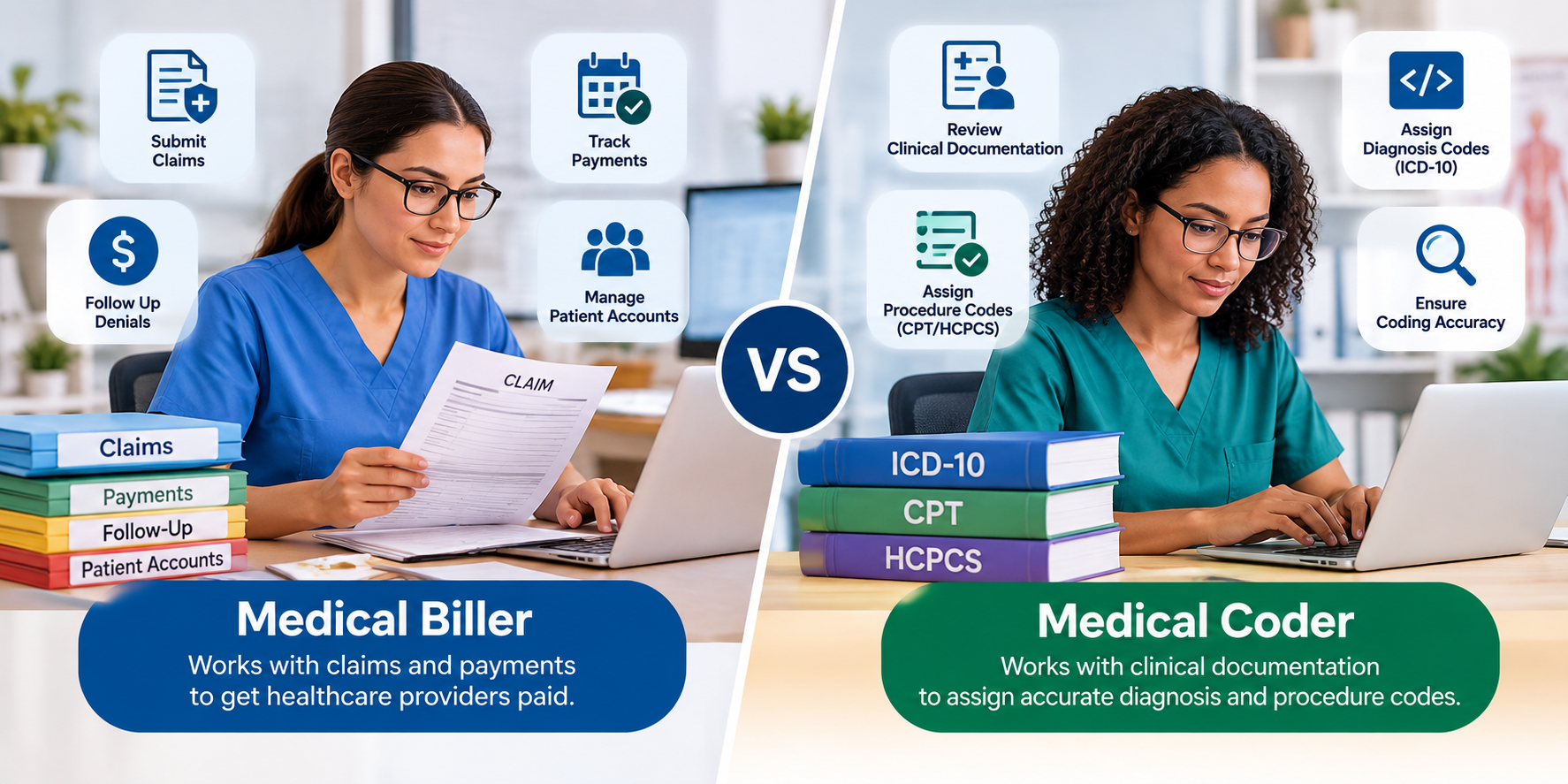
"Medical billing" and "medical coding" get used interchangeably so often that most people assume they're the same job. They're not. They're two separate steps in the same process, handled by two different skill sets and understanding the difference matters whether you're hiring for one of these roles or just trying to understand who's doing what with your claim.
What Does a Medical Coder Do?
A medical coder reviews the provider's documentation from a visit the diagnosis, the procedure, the notes and translates it into standardized codes. These are CPT codes for procedures and services, and ICD-10 codes for diagnoses. Coding requires close attention to clinical detail: the wrong code, or a code that doesn't match the documentation, can cause a claim to be denied before it ever reaches a human reviewer at the insurance company.
What Does a Medical Biller Do?
A medical biller takes those codes and builds them into a claim, submits it to the insurance company, and follows the claim through to payment. That includes verifying insurance eligibility beforehand, correcting and resubmitting claims that come back with errors, working denials, and billing the patient for whatever portion insurance doesn't cover. Where coding is about accuracy, billing is about follow-through getting the claim paid, not just getting it submitted.
How Billing and Coding Work Together?
Think of it as a relay. Coding hands off a translated, standardized version of the visit. Billing takes that translation and carries it the rest of the way through submission, payer review, and collection. A perfectly coded claim can still get denied over a billing error, like a missed filing deadline or a mismatched patient ID. And a perfectly submitted claim can still get denied over a coding error, like a diagnosis code that doesn't support the procedure billed. Neither role can fully cover for the other.
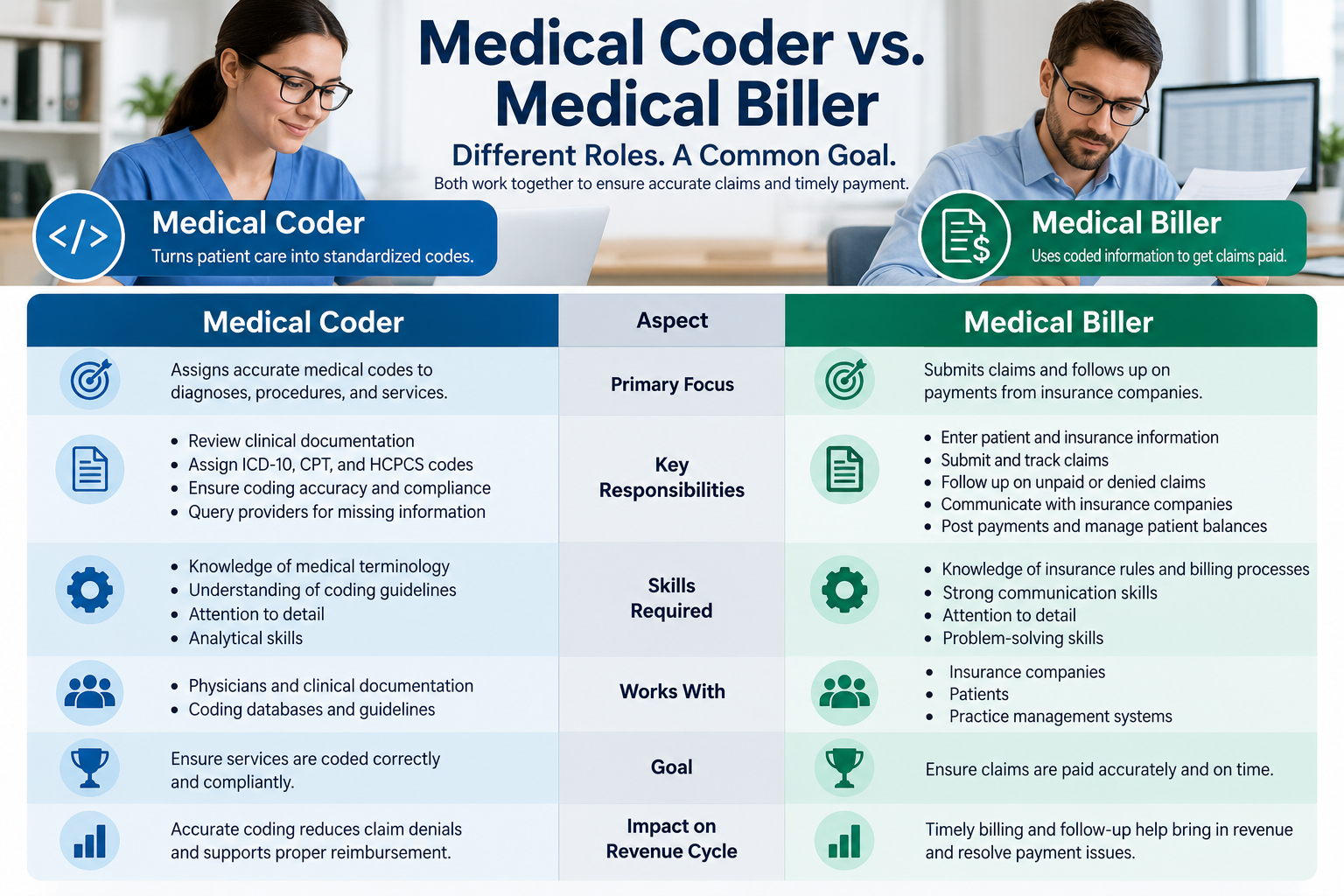
Medical Billing vs. Medical Coding: Key Differences
| Medical Coding | Medical Billing | |
|---|---|---|
| Main task | Translates clinical documentation into CPT/ICD-10 codes | Builds and submits claims, follows up on payment |
| Works closest with | Clinical notes and provider documentation | Insurance payers and patient accounts |
| Common credential | CPC (Certified Professional Coder) | CPB (Certified Professional Biller) |
| Where errors show up | Wrong or mismatched codes | Missed deadlines, eligibility issues, unworked denials |
| Focus | Accuracy of the clinical translation | Getting the claim paid |
Do You Need a Certification for These Roles?
Certification isn't always legally required, but it's the industry standard most employers look for. Coders typically pursue a Certified Professional Coder (CPC) credential through AAPC or a similar body. Billers often pursue a Certified Professional Biller (CPB) or similar credential. Certification signals a working knowledge of coding guidelines, payer rules, and compliance requirements the kind of thing that's hard to verify from a resume alone.
Can One Person Do Both Jobs?
In smaller practices, yes it's common for one person to handle both coding and billing, especially in a solo or small-group setting where claim volume is manageable. In larger practices and hospitals, the roles are usually split, since each one benefits from specialization at scale. Many practices that start with one combined role eventually separate them, or outsource one or both, once claim volume grows past what a single person can manage accurately.
Billing and Coding as a Career Path
Both roles offer a path into healthcare administration without a clinical degree, and both can be done remotely, which has made them increasingly popular career choices. Coding tends to appeal to people who like detail-oriented, documentation-heavy work. Billing tends to appeal to people who like problem-solving and follow-through chasing down a denial until it's resolved is a very different daily rhythm than coding a chart.
Frequently Asked Questions About Medical Billing and Coding
Can one person do both billing and coding?
Yes, and it's common in smaller practices. As claim volume grows, many practices eventually split the roles or outsource one of them to keep both accuracy and follow-through from slipping.
Which pays more, billing or coding?
Pay varies by region, experience, and certification, and the two roles overlap enough that it's hard to generalize. Specialized coding (certain surgical or risk-adjustment coding, for example) can command a premium, as can experienced billers who manage complex payer relationships and denial recovery.
Do I need a certification to work in medical billing?
It's not always legally required, but most employers treat a recognized credential, like a CPB, as the standard. It demonstrates familiarity with payer rules and compliance requirements that are difficult to pick up without structured training.
The Bottom Line
Medical coding and medical billing are two halves of the same process, not two names for the same job. Coding turns a visit into an accurate clinical translation. Billing turns that translation into a paid claim. A practice that treats them as interchangeable or leaves both to one overloaded person past the point that's sustainable is usually the same practice fighting an avoidable denial backlog a few months later.
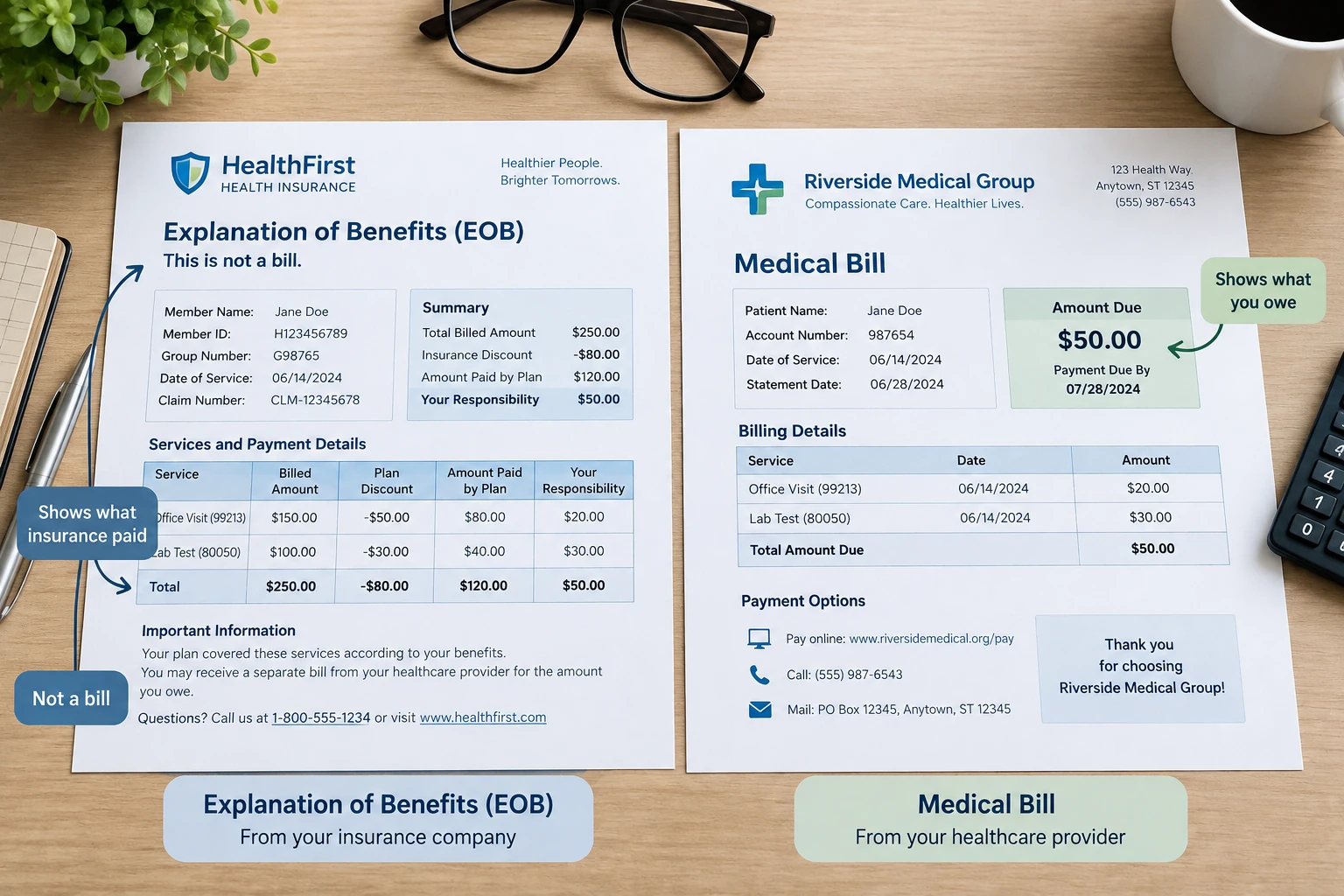

See what's slowing your revenue cycle.
A focused review of your claims, denials, A/R, and credentialing gaps. No obligation, no software to install.